Imagine that your preferred apocalyptic scenario has taken over the planet. It could be I Am Legend, Dawn of the Dead, War of the Worlds…hopefully not The Road (which you will understand if you have read this excellent yet horribly depressing novel.) Basically civilization has collapsed, public amenities are no longer available, and you now have to come up with a plan for survival. It is now you against the world.
Many musicians view their uphill battle to achieve creative success as an I Am Legend scenario. It’s you against the zombies and you are desperately hoping that you don’t have to choke out your German Shepherd. Seriously though, musicians commonly imagine themselves stranded on an island of creativity and spend countless hours trying to learn how to do every single role relevant to managing a band or artist name. You have to learn to grow crops, operate a rifle, research anti-zombie medicine, etc. (i.e. engineering the recording process, distribution, promotion, etc.) While I commend people’s efforts to learn a variety of skills, I find it ridiculous to put it on yourself to become an expert in a bunch of subjects and skills that really have nothing to do with each other. Do you expect your general practitioner to do your annual health check-up and then follow up by changing the tires on your car?
What am I getting at here? So it turns out that other musicians actually DO exist and that many of them possess skills that you could help you in great ways. The opposite is likely true as well: you can help other musicians with your personal set of skills and knowledge (KNAHWLEDGE). Again, imagine your post-apocalyptic survival scenario. The worst-case scenario is that it’s just you against the zombie horde; you will likely do one or two things very well but succumb to the deadly elements of one of your skill blind spots. A similarly unhelpful scenario is if you are stuck with five other people with your exact skillset. Okay great, we all know how to filter water and change the oil in a car, but that is not going to help us eat or keep our house warm in the winter. Who has the best odds of surviving the zombie onslaught? A diverse community of people who all contribute their strongest skillset to keeping the community alive.
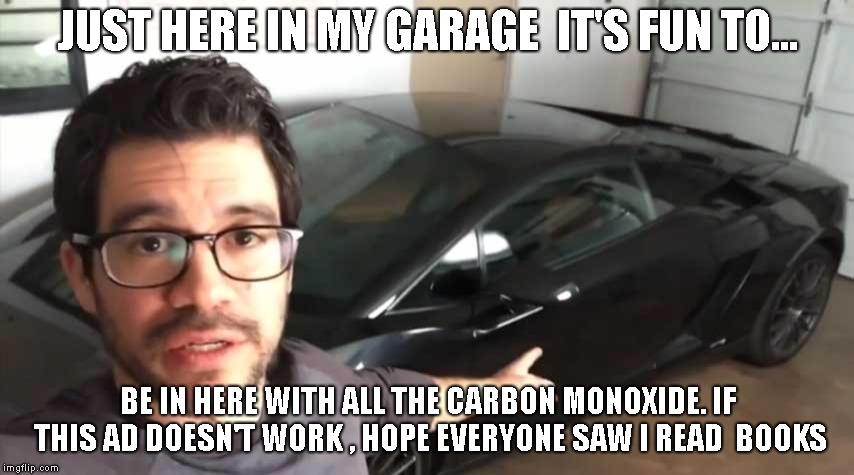
Does anyone else remember Tai Lopez, or am I officially old and out of touch?
Moving past the metaphors: establishing community with your fellow musicians is a great way to build relationships, learn new ideas and strategies, and, yes, even selfishly promote your music. Many bands try to accomplish this within the band itself, i.e. they hope that, between the four members, they can cover all of the necessary tasks to achieve “success”. Unfortunately this scenario is…pretty unlikely. You can cover a LOT of ground this way, do not get me wrong, but it is unlikely that four people can wear 16 hats. If you increase your circle to 5 bands with 4 members….now you have 20 heads for 16 hats. Your rhythm guitarist with the gorgeous set of locks does not even need a hat and can fulfill their role by looking beautiful in the corner.
I WILL BE POSITIVE ABOUT MUSICIANS FOR A MOMENT
In specific scenarios I actually do see local DIY musicians forming community. Live music is the #1 example; certain people are really inspired to set up local shows and are willing to cold-call a whole bunch of different artists to make it happen. Some folks put together playlists of a bunch of their favorite local musicians, in an effort to help people interested in “insert your city name” bands to actually find them. I actually met a woman (sorry I don’t remember your name…) who put together a paper-only newsletter highlighting around 100 local shows per month in the Cleveland area. Let me be clear: these people are AMAZING. Now I’ll take it a step further: we all have the potential to be these people.
BACK TO NEGATIVITY….
Sometimes I hate that music and money have such a close association in our society. The reality is that there really is not much money in music to spread out across the millions of aspiring singers, guitarists, producers, engineers, rappers, etc. We tend to focus on the part that is unlikely to happen (making money) instead of the wonderful experiences that are very achievable. I highly recommend the (now late) great Steve Albini’s article “The Problem With Music” in which he lays out some very realistic yet depressing accounting for a hypothetical band’s experience working with a major label. Sure, a lot of people made a lot of money in the recording and distribution of this band’s album, yet the artist magically did not receive any of said money. What is even worse is that this hypothetical band very likely had to compromise their own creative vision by working with the major label. Is it worth having thousands or millions of fans if you are not even making the music that you truly want to make AND all of the money seems to be just out of reach?
I say this from a place of privilege, BUT….I find the process of writing, recording, and releasing music to be far more palatable when I ignore the money aspect and focus on the creative aspect. I mention “privilege” because I recognize that I do not actually have to make any money from my music. My day job is secure and relatively flexible, leaving me plenty of time to pursue my creative endeavors. But guess what? Many “successful” musicians have the same story. It turns out that it is far easier to launch a successful music career if you have been raised on a financial cushion and can focus your time and energy on your art instead of, you know, surviving this capitalist hellscape.
Most of us in the DIY music scene are somewhere in the middle: we cannot spend 40 hours per week on music, but we do have enough time, energy, and money to create on some level. I personally view this as a beautiful thing. Only in the last 20 years or so has it been possible to create a great-sounding album and make it available to anyone in the world with an Internet connection. This feat used to be prohibitively expensive.
LET’S GET TO THE POINT: COMMUNITY
Musicians can do a lot more to help each other create and release their music. Oh, you want examples? I’m glad that you asked:
- Going to your friends’ shows in your hometown goes a LONG way. Recording portions of their set and sending it to them goes even further.
- Going to strangers’ shows and recording (without blocking someone else’s view; don’t be a dick) is even more amazing.
- When other DIY artists have a release it makes a world of difference to create some quick social media engagement, such as commenting on their post or sticking their release in your stories for a day.
- I despise using social media, so this is probably my personal #1.
- I have a huge smile on my face every time another artist shares my stuff or sends me a kind DM.
- If you have a home studio and help other artists record their music for under $200 per song, then you are an absolute saint (shout out Chris @rubberlizardrecords and Cory @sonicexplorermusic).
- Buying merch is, of course, awesome.
- If you are like me, then you already own too many black T-shirts. Seriously, I have at least 75. Now I just buy artists’ digital albums on Bandcamp for $5. This is monetarily equivalent to about 1,000 streams.
- Creating playlists and putting DIY artists in said playlists genuinely helps the artists reach a wider audience, both via the playlist and the algorithm recognizing the engagement.
- Collaborations are severely underrated and are arguably the single greatest form of promotion.
- DIY blogs, podcasts, fanzines, artwork, compilations, record labels, shows, festivals, etc. really do make a HUGE difference. Even if your engagement is low (believe me, I know all about this….) you are still validating the artist and giving them something to share with the world.
- Advice can go a long way too. Chances are that you are really good at certain music-related tasks and suck at others. Guess what? Everyone can relate.
My goal is not to be accusatory. I could do a LOT more for my local music community. In some ways, this article is more of a reminder to myself that, yes, I love making my own music, but I love other people’s music too, and I need to make sure that I am supporting them. And here’s the best part of it all: you only have to build community with artists whose art you genuinely enjoy. There are so many artists in the world that it is a pointless endeavor to pretend to like someone’s music for the sake of trying to get something from them. If you find yourself saying “but I don’t like any artists in my area”, then you need to give yourself a reality check. You are either 1. a pretentious asshole 2. living under at least 10 proverbial rocks 3. in a location that is hopelessly small and remote for a thriving music scene.
We would kill off all of the infamously parasitic players in the music industry if we spent more time and energy building community with one another. In the last 20 years we have watched DIY artists soar to greater heights than ever before, and, despite their tenacious work ethic, they certainly did not achieve their success on their own. While I cannot guarantee financial success for every artist, I am confident that we all can find creative success via the power of community.
Thanks to Marc from Orion’s Sword for inspiring this article!
Joe H


 Musicians: Take Note!
Leave a comment